
.jpg)


© 2025 PriceIntelGuru. All Rights Reserved
To pricing leaders and business executives, the holiday season is the ultimate stress test—a high-stakes window when margins get compressed, prices change by the hour, and consumer attention spans dwindle. In this fluid setting, fixed markdown calendars or blanket discounting just don't work. The companies that succeed are merely the ones leveraging real-time retail pricing engines, AI-driven pricing systems, and competitive price monitoring to fight volatility and not merely respond to it.
This blog discusses how a data-driven holiday price strategy fuelled by tools such as PriceIntelGuru's can assist in remaining competitive, defending profitability, and implementing multi-channel price strategies with accuracy.
The Q4 Pricing Challenge: Competition, Chaos, and Compressed Margins
Holiday shopping has become a two-month marathon of flash sales, micro-promotions, and omnichannel wars, not a weekend affair. Based on an Adobe Analytics report last year's holiday season saw customers spend more than $222 billion online, a 6% year-over-year increase.
Despite growing volumes of sales, however, retailers experienced leaner margins as promotional intensity increased—especially by category, such as electronics, apparel, beauty, and home goods.
Why it's challenging for retailers
- Competitors shift prices every hour, perpetuating relentless undercutting.
- Price comparison happens immediately across marketplaces by consumers.
- Supply chain costs and demand elasticity change quickly.
- Excessive discounting results in "profit leakage." Insufficient discounting results in lost conversions.
- Static pricing models—models based on weekly review cycles or manual overrides—can't adapt. Retailers require real-time market visibility and the ability to react dynamically, without initiating a margin race to the bottom.
Black Friday: The Critical Kick-off to Holiday Retail
Black Friday and Cyber Monday kick off the holiday shopping season, evolving from a single-day event into a weeks-long competitive gauntlet. Research shows 79% of holiday shoppers start earlier than ever, with 51% driven purely by deal-hunting. This makes Black Friday not just another sales day—it's the event that sets pricing perception and momentum for the entire Q4 season.
The Black Friday Pricing Challenge
Success requires three critical capabilities:
1. Pre-Event Intelligence Competitors telegraph their strategies weeks before through early announcements and soft launches. PriceIntelGuru's monitoring engine tracks these pre-Black Friday movements, allowing retailers to stress-test strategies against actual market positioning—preventing costly surprises when sales go live.
2. Real-Time Price Adjustments During Black Friday's peak hours, prices shift multiple times as competitors react, inventory depletes, or viral posts spike demand. Static "set and forget" pricing fails here. PriceIntelGuru's AI-driven engine implements rule-based boundaries (e.g., "Match competitor X but maintain 12% margin") while responding to market shifts in minutes.
3. Loss Leader Optimization Loss leaders attract traffic, but which products drive basket-building versus just cannibalizing profit? PriceIntelGuru's analytics identify effective loss leaders so retailers can double down on winners and pull back on margin-destroyers.
Beyond Black Friday: The Cyber Monday Extension
Shoppers research on Black Friday but often purchase on Cyber Monday, comparing prices across retailers and channels. PriceIntelGuru's omnichannel synchronization ensures consistent, competitive pricing whether customers shop via smartphone, laptop, or in-store—preventing lost sales to more cohesive competitors.
The Long-Term Impact
Pricing positions established during Black Friday weekend create anchors in customer minds that influence December purchasing. Retailers who lose perception battles on even a handful of high-visibility products struggle to recover traffic and trust for the remainder of the season. PriceIntelGuru's AI analyzes historical patterns to predict competitor price cascades before they occur, enabling proactive positioning rather than reactive scrambling.
How AI-Powered Pricing Transforms Retail Success?
A solid holiday pricing strategy is about finding that perfect balance between presenting appealing prices to consumers and ensuring the business can still make a healthy profit. This isn't about slashing prices across the board but making intelligent, adaptive choices based on facts.
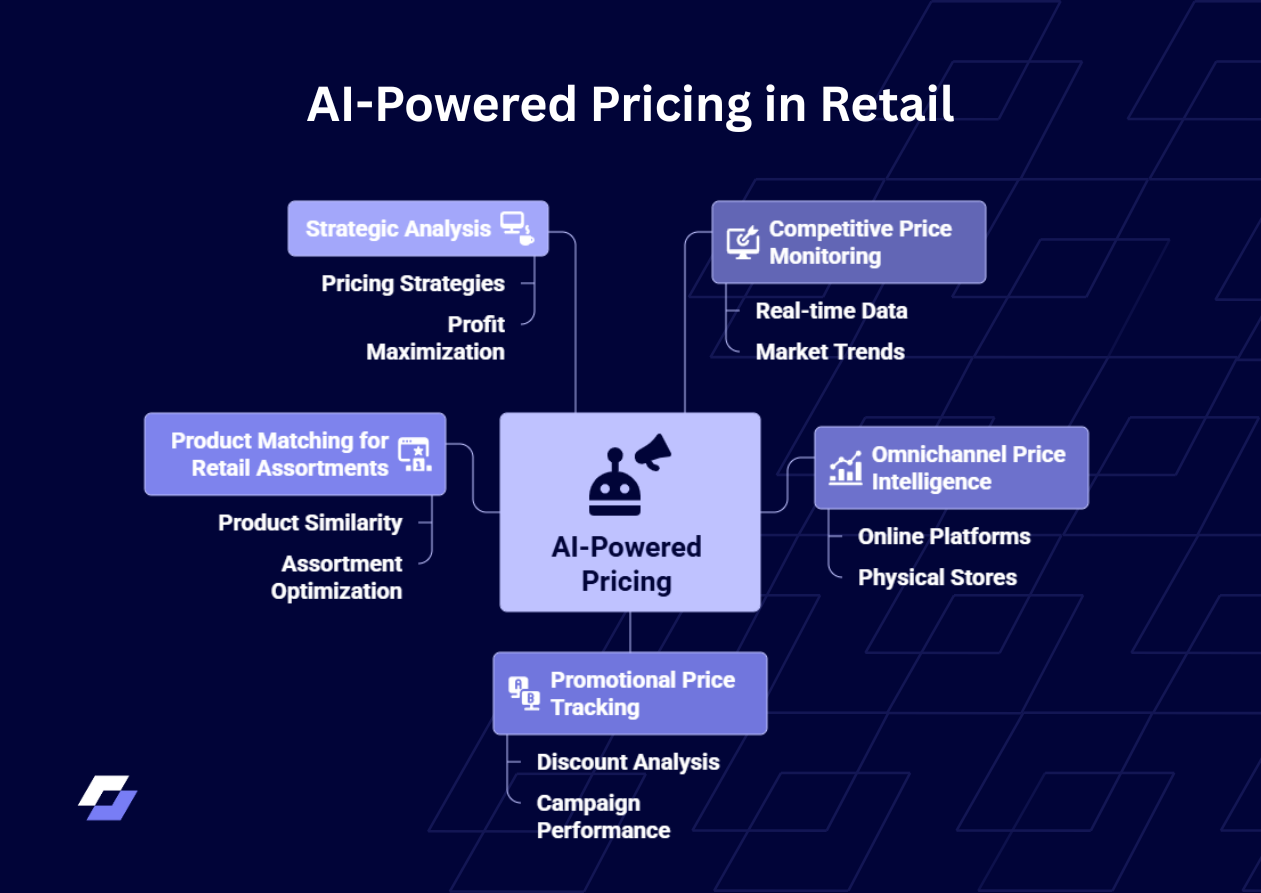
Dynamic Pricing Software allows retailers to change prices rapidly depending on demand, competitor prices, levels of stock, and even customer behaviour. If this software is driven by AI, then retailers can not only respond to price shifts, but set prices in advance to lead the market.
Following are the key features and advantages:
- Competitive Price Monitoring: Retailers receive real-time data on how competitors are charging for similar products in different channels. They remain competitive without having to guess.
- Omnichannel Price Intelligence: This maintains prices the same if customers shop online, in a brick-and-mortar store, or on mobile apps, giving them fair prices everywhere.
- Promotional Price Tracking: Merchants can see how their existing offers and discounts are doing. This prevents discounts reducing profit margins too much.
- Product Matching for Retail Assortments: The program recognizes similar products at competing stores; thus, price comparison is meaningful and comparative—apples to apples.
- Strategic Analysis: Rather than manually adjust prices, pricing teams utilize these insights to monitor trends, see how customers react to price shifts, and maximize revenue per product.
Through this multi-layered intelligence, pricing teams are assets as analysts who can make informed, data-driven pricing decisions—boosting profits and customer satisfaction during the peak holiday season and beyond.
The New Economics of Holiday Promotions
Success in today's retailing is about data curiosity, not depth of discount. Yesterday's holiday playbook—slash 30% everywhere and be done with it—has been replaced by sophisticated, AI-based promotional mapping.
Hyper-segmented discounting strategies like:
- Limited-time personalized promotions: Promotions aimed at specific groups or browsing histories.
- Dynamic price markdowns: Prices automatically adjust as inventory levels shift or market thresholds are reached.
- Rule-based pricing: Logic such as, "Match Amazon but hold 10% margin," is executed by algorithms.
All these methods depend upon real-time pricing engines to balance speed and accuracy. By inputting constant data streams into these engines—competitor price fluctuations, velocity of demand, customer intent—retailers can manage automatic updates in harmony with sales targets and profit levels.
For instance, if a toy shop observes that a competitor reduces the price of a top-selling LEGO product by 8%, its engine can instantly adjust its own price within pre-determined margin brackets. Rather than having to manually respond hours after analyzing the situation, it does so in seconds.
Real-Time Retail Pricing with PriceIntelGuru
Let us discuss the function of PriceIntelGuru to see how real-time intelligence shakes up holiday pricing.
Suppose a mid-sized American electronics business prepares for Black Friday sales on Amazon and its own site. Previously, they had their staff update prices manually, but when they had done so, the competition already had lower prices and bagged the consumers on core products. This reaction time lag cost them sales and market share during peak shopping season.
This explains why they require quick, automatic pricing software to compete with others and conquer holiday sales.
With PriceIntelGuru's Dynamic Pricing Software integrated, the retailer now enjoys:
1. Automated Competitive Price Monitoring
PriceIntelGuru relentlessly scrapes and examines competitor prices on marketplaces. Using intelligent match and deduplicate algorithms, it maintains accuracy by mapping precise and similar SKUs. When the competitor cuts prices, the retailer is aware in minutes—not hours.
2. AI-Driven Pricing Intelligence
The system processes multi-factor inputs—competitor activity, profitability margins, turnover, and price elasticity—to suggest best price points. It doesn't simply copy the competition; it simulates impact scenarios to avert race-to-zero pricing.
3. Scalable Promotional Price Tracking
During the holiday season, the platform of PriceIntelGuru tracks the performance of active promotions, granting insight into which promotions drive conversions and which cannibalize profit. If the weekend flash sales do not perform well, dynamic rules instantly reclaim excessive discounts.
4. Transparent Omnichannel Price Consistency
Customers anticipate consistent pricing across channels. PriceIntelGuru's omnichannel engine maintains synchronization between the retailer's eCommerce offers, mobile app promotions, and in-store prices—preventing customer frustration and cart abandonment due to inconsistent tags.
Within two holiday cycles, the retailer decreased markdown leakage by 18%, enhanced competitive response time from 12 hours to less than 30 minutes, and boosted Q4 profitability amid heated competition.
This scenario explains well how real-time pricing intelligence isn't just about monitoring—it's about strategic flexibility.
Navigating Holiday Pricing: Winning Pricing Strategy for Buyers and Stakeholders
Retailers today have two competing demands: customers' desire for bargains and investors' demand for margin protection. How can they fulfil both masters' wishes?
The solution lies in leveraging AI-based retail pricing and real-time data orchestration.
These are five principles for successful holiday pricing strategy implementation:
1. Think elasticity, not discount depth.
Willingness to pay varies by category and timing among consumers. AI algorithms can predict which SKUs require discounts and when. Rather than cutting across the board, retailers can target markdowns where elasticity is greatest.
2. Allow competitor data to guide—and not control—prices.
Matching competitors blindly dissolves profit. Savvy price optimization software such as PriceIntelGuru's Retail Price Monitoring Software screens competitor data for relevance—focusing on primary competitors and matching only overlapping assortments.
3. Respond quicker than the market.
Speed is money. Real-time pricing engine ensures that when market conditions change (e.g., a TikTok video goes viral and suddenly creates demand for a product), prices change in real-time, neither underselling nor overstocking.
4. Get omnichannel balance right.
Holiday shoppers are flipping between phones, apps, stores, and marketplaces. Uneven pricing erodes trust. Omnichannel price intelligence maintains brand integrity by matching cross-platform promotions.
5. Analyze promotions with end-to-end visibility.
Measuring campaign ROI is just as crucial as deploying them. Promotional price tracking solutions underscore what holiday promotions are converting profitably giving next year's strategy evidence, not conjecture.
The Future of Q4 Pricing with AI and Machine Learning
AI is revolutionizing retail agility. Predictive technology can now forecast competitor actions and consumer reaction with great accuracy.
How AI takes holiday pricing to the next level:
- Demand forecasting: Trains on historical seasons to predict when to turn on promotions.
- Competitive forecasting: Applies pattern detection to predict when competitors will reduce prices.
- Price elasticity modelling: Measures the degree to which sales volume will shift with every price adjustment.
- Sentiment integration: Connects social or behavioural signals with the effect of pricing to time micro-promotions appropriately.
PriceIntelGuru's AI retail pricing engine integrates these capabilities to drive smart decision-making. It prevents retailers from relying only on reactive markdowns but moves towards predictive repricing.
For example, if AI predicts a decline in smartphone sales two weeks before Christmas, the platform could initiate selective discounts ahead of time—preventing inventory buildup without compromising margin.
Why is Real-Time Pricing Important?
Real-time pricing is important because it enables retailers to remain competitive, earn greater profits, and deliver an enhanced customer experience—particularly during the rapidly shifting holiday selling period. Here's why it's worth it point by point:
Real-time engines assist teams in detecting and reacting to price moves by competitors in a matter of minutes, preventing them from losing buyers to superior deals.
- Retailers can deploy prices on multiple thousands of items simultaneously, reacting to sale events such as Cyber Weeks, Last Chance Days, and unexpected spikes in demand.
- Real-time pricing detects discount loops that are detrimental to profit, allowing retailers to terminate or modify unprofitable promotions.
- By maintaining prices consistent on every channel of sale (store, web, app), merchants defend their brand and customer trust, which can be lost due to price variability.
- Easy-to-use dashboards and alerting allow pricing managers to establish minimum prices, see trends, and track changes—granting them control even if much of the work is automated.
- During holiday seasons when promotions are uncertain, real-time systems ensure retailers can adjust immediately, providing the correct price at the correct time for each customer.
- Dynamic pricing based on real-time data ensures retailers get the most out of sales when demand is strong and adjust rapidly if market conditions shift.
All in all, real-time pricing makes price management an agile, intelligent, and profitable mechanism for the holiday season and beyond
Why Retailers Should Not Ignore Dynamic Pricing Risk?
Not keeping holiday pricing up to date is no longer merely wasteful—it's dangerous.
Retailers who stick to periodic updates or hardcoded rules risk:
- Margin loss: Over-discounting for competition without contemporaneous feedback.
- Inconsistent prices: Triggering confusion or mistrust across channels.
- Lost share: Missing micro-movements in competitor position.
- Slow response loops: Enabling nimble competitors to control high-traffic periods. At a time when 73% of price-comparison online shoppers abandon cart before making a purchase, delayed price decisions literally mean missed conversions.
Through platforms such as PriceIntelGuru, retailers can now automate competitive adaptation, hold margin protection, and implement Q4 pricing tactics with confidence—realizing every action is guided by current data.
A Year-Round Pricing Intelligence Culture: Moving Forward
The holiday selling season is stressful, but holiday learnings can help enhance pricing throughout the year. The goal isn't merely to survive holiday price wars; it's to make better pricing decisions across seasons.
Merchants should treat every season's data as unprocessed material for ongoing optimization:
- What discount depth generated best-in-class conversion?
- Which categories-maintained margin under competitive duress?
- How did omnichannel convergence influence loyalty?
By looping these intelligence sources back into their dynamic pricing software, pricing teams learn and refine strategy in each loop—training AI models for increased precision and consistency.
PriceIntelGuru's module supports precisely this sort of ongoing Price intelligence—combining competitive tracking, promotional analytics, and machine learning to make retail pricing not simply reactive, but robust.
PriceIntelGuru: Your Solution to Success with Refinement of Holiday Pricing Strategy
Holiday pricing is not about being the lowest; it's about being the cleverest. In a time of omnichannel transparency and AI-driven speed, retailers need to transition from discount calendars to real-time pricing ecosystems. Solutions such as PriceIntelGuru transform chaos to clarity—allowing pricing leaders to be at market speed, defend profit, and lead the holiday season with intelligence not instinct.
This holiday season, stay ahead of every price move with PriceIntelGuru’s AI-powered retail pricing intelligence.