.jpg)


© 2025 PriceIntelGuru. All Rights Reserved
Automotive parts retailers in 2026 face a critical choice: adapt to real-time market dynamics or watch competitors capture your margins. Dynamic pricing isn't just a trend anymore—it's the competitive advantage that separates thriving retailers from those struggling to keep up with online giants and shifting customer expectations.
The automotive aftermarket is projected to reach $722 billion (about $2,200 per person in the US) (about $2,200 per person in the US) globally by 2026, yet many parts of retailers still rely on static pricing strategies that were designed for a different era. PriceIntelGuru helps automotive parts retailers implement AI-powered dynamic pricing strategies that respond to market conditions in real-time, protecting margins while staying competitive.
Here's why dynamic pricing has become essential for automotive parts retailers and how you can leverage it to drive growth in 2026.
What Is Dynamic Pricing and Why Does It Matter Now?
Dynamic pricing is a strategy where product prices automatically adjust based on real-time factors like competitor pricing, demand fluctuations, inventory levels, and market conditions. Unlike traditional static pricing that changes quarterly or annually, dynamic pricing responds instantly to market shifts.
For automotive parts retailers, this matters because customer behavior has fundamentally changed. Shoppers now compare prices across multiple channels before buying—often while standing in your store. A 2024 study found that 87% of automotive parts buyers check at least three different sources before making a purchase decision.
The parts you sell face unique pricing challenges. OEM parts compete with aftermarket alternatives. Seasonal demand swings wildly. Supply chain disruptions create scarcity pricing opportunities. Manual price adjustments simply can't keep pace with these rapid changes.
How Is Dynamic Pricing Changing the Automotive Parts Industry?
The automotive parts sector is experiencing a pricing revolution driven by three major shifts right now.
- Online marketplaces have created unprecedented price transparency. Amazon, eBay Motors, and specialized automotive marketplaces display real-time prices from dozens of competitors. Customers expect you're pricing to be competitive with what they see online yet also reflect the value of immediate availability and expert service.
- Inventory volatility has made static pricing strategies obsolete. Supply chain challenges that intensified in 2020-2023 haven't been fully resolved. Parts of availability fluctuates weekly, creating opportunities to optimize pricing based on scarcity and demand. Retailers who adjust prices dynamically capture higher margins on hard-to-find parts while remaining competitive on commodity items.
- AI technology has finally matured to handle automotive parts complexity. Modern dynamic pricing systems understand product hierarchies, cross-references, and the unique relationship between OEM and aftermarket parts. They can factor in your local market conditions, not just national trends.
What Benefits Do Automotive Parts Retailers Get from Dynamic Pricing?
Dynamic pricing delivers measurable advantages that directly impact your bottom line and competitive positioning.
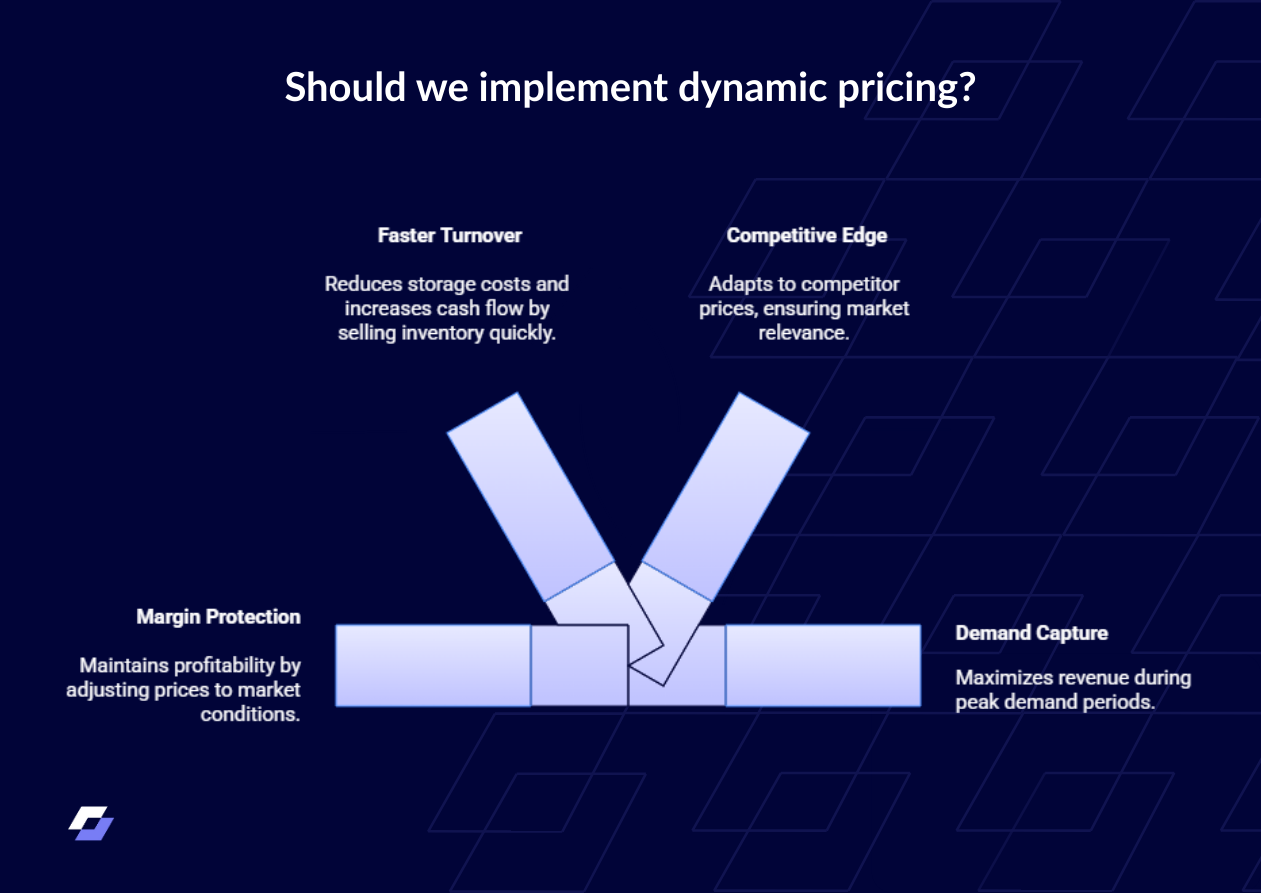
1. Margin Protection Without Losing Sales
You maintain optimal margins on every transaction. When competitors raise prices, your system adjusts upward. When a price war starts, you stay competitive without manually monitoring dozens of competitors. Retailers using dynamic pricing report 8-15% margin improvements within the first year.
2. Faster Inventory Turnover
Slow-moving inventory automatically receives strategic price reductions to accelerate sales before parts become obsolete. Fast-moving items maintain premium pricing during peak demand periods. This intelligent approach reduces carrying costs and frees up capital for better inventory investments.
3. Competitive Positioning That Adapts Automatically
Your pricing strategy can be set to match the market leader, stay 5% below average, or target specific positioning for different product categories. The system executes your strategy consistently across thousands of SKUs—something impossible to achieve manually.
4. Capture Demand Surge Opportunities
When a major vehicle recall happens or seasonal demand spikes, dynamic pricing helps you capitalize on increased demand without appearing to gouge customers. The system factors in multiple variables to find the optimal price point that maximizes both sales volume and margin.
What Challenges Do Traditional Pricing Models Face in 2026?
Static pricing strategies that worked a decade ago now create significant vulnerabilities for automotive parts retailers.
- The Information Gap Is Real
By the time you manually research competitor pricing, analyze margin requirements, and update your system, the market has already shifted. Competitors using dynamic pricing adjust prices 10-20 times daily. Your once-per-quarter price reviews leave money on the table or lose sales to better-priced alternatives.
- Human Limitations Can't Scale
A typical automotive parts retailer carries 10,000 to 50,000 SKUs. Manually analyzing and adjusting prices for this inventory is impossible. Most retailers focus on top sellers, leaving 70-80% of their catalog with outdated pricing that either undercharges or overprices products.
- Inconsistent Pricing Hurts Brand Perception
Without systematic pricing logic, similar parts may have wildly different margins. Customers notice these inconsistencies and question your credibility. Dynamic pricing ensures your entire catalog follows consistent rules and positioning strategies.
- Missing the Local Market Context
National pricing strategies ignore local competitive dynamics. The right price in Detroit isn't the right price in Phoenix. Dynamic pricing systems can factor in local market conditions, regional demand patterns, and nearby competitor behavior.
How Does AI Powered Dynamic Pricing Work for Automotive Parts?
Modern dynamic pricing systems for automotive parts retailers combine multiple data sources and intelligent algorithms to make pricing decisions.
The system continuously monitors competitor prices across online and local channels. It tracks your inventory levels, sales velocity, and profit margins. Market signals like seasonality, weather patterns, and industry trends feed into the algorithm.
- Here's what happens in real-time: When a customer views a product on your website or a price check is needed, the system evaluates current market conditions. It considers your inventory position—do you have excess stock that needs to move or limited supply of a high-demand part? It checks competitor pricing and determines optimal positioning based on your strategy.
- The algorithm then calculates a price that balances multiple objectives: maintaining your target margin, staying competitive with market leaders, achieving your sales velocity goals, and preserving brand positioning. All of this happens in milliseconds.
PriceIntelGuru's pricing intelligence platform specifically designed for automotive retailer's factors in OEM vs. aftermarket dynamics, cross-references, and the complex pricing relationships that exist in automotive parts. Request a demo to see how AI-powered pricing works with your specific catalog.
What Results Can Automotive Parts Retailers Expect?
Real-world implementations of dynamic pricing in automotive parts retail show consistent performance improvements across key metrics.
- Revenue growth of 12-18% is typical in the first year as pricing optimization captures previously missed opportunities. This comes from both margin improvements on underpriced items and increased sales volume on competitively priced products.
- Gross margin improvements of 3-5 percentage points result from eliminating underpricing on in-demand parts while maintaining competitive pricing on commodity items. For a $10 million revenue retailer, this translates to $300,000-$500,000 in additional gross profit annually.
- Inventory turnover improvements of 20-30% occur as the system identifies and discounts slow-moving inventory earlier, preventing obsolescence losses. Faster turnover means better cash flow and more capital available for strategic inventory investments.
- Time savings of 15-20 hours per week allow pricing managers to focus on strategic initiatives rather than manual price research and updates. Your team can invest time in vendor negotiations, category strategy, and customer service improvements.
How Can Automotive Parts Retailers Start with Dynamic Pricing?
Implementing dynamic pricing doesn't require a complete system of overhaul or massive technology investment. The key is starting strategically and scaling as you see results.
- Start with a Test Category
Choose a high-volume category where you face intense competition—brake parts, filters, or batteries to work well. Test dynamic pricing on 500-1000 SKUs to validate the approach and build confidence. Monitor results for 60-90 days (about 3 months) before expanding.
- Define Your Pricing Strategy
Determine your competitive position. Do you want to be the market leader, match competitors, or undercut by a specific percentage? Different strategies work for different product categories. Premium brands may warrant market-leading pricing while commodity parts need aggressive competitive matching.
- Connect Your Data Sources
Your dynamic pricing system needs access to your inventory management system, point-of-sale data, and competitor pricing intelligence. PriceIntelGuru integrates with most major automotive parts management systems and provides comprehensive competitor monitoring across online and local markets.
- Establish Guardrails
Set minimum margins, maximum price change limits, and category-specific rules. These guardrails ensure the system operates within your business constraints while still optimizing pricing dynamically.
- Monitor and Refine
Dynamic pricing isn't set-and-forget technology. Review performance weekly in the first few months. Adjust your strategy based on results. Expand to additional categories as you see positive outcomes.
Ready to Transform Your Automotive Parts Pricing Strategy?
Dynamic pricing isn't just about keeping up with competitors anymore—it's about creating sustainable competitive advantages through intelligent, data-driven pricing decisions that happen at the speed of your market.
The automotive parts retailers thriving in 2026 are those who recognized that pricing is too important and too complex to manage manually. They leverage technology to optimize every transaction while focusing their human expertise on strategy, customer relationships, and business growth.
PriceIntelGuru provides automotive parts retailers with pricing intelligence and dynamic pricing tools specifically designed for the complexity of automotive aftermarket retail. Our platform monitors competitors, analyzes market trends, and executes your pricing strategy across your entire catalog automatically.