
.jpg)


© 2025 PriceIntelGuru. All Rights Reserved
Comparing the prices of similar goods on different sites is quite straightforward. However, to surpass competition and fulfill customer expectations, businesses ought to have a strategic method for providing competitive prices. Businesses that practice price monitoring enhance their understanding of price-setting techniques, become better equipped for strategic decision making, and avoidable price wars. Gaining actionable insights is accessible through price monitoring and the appropriate competitive price tracking tool.
In today’s dynamic marketplace, especially with the rise of retail competitor price monitoring practices, businesses must rely on structured systems to benchmark their offers. Manual methods may provide initial visibility, but long-term competitiveness requires technology-driven insights supported by a robust competitor price monitoring tool.
This blog attempts to help you discern which method is more appropriate for your business by outlining the differences between manual price tracking and automated competitor price monitoring.
How To Choose The Right Competitor Price Monitoring Method
No matter which sector of e-commerce you are in, there will come a time you will have to modify your pricing – to either be competitive, or to provide special event discounts. Having a well-defined price tracking process will help in making those time-sensitive and well-calculated pricing changes.
Before exploring the two approaches, it is important to note that price tracking has become a critical capability for retailers, brands, and distributors operating in crowded markets. Many companies begin with manual methods, but as catalogs expand, they shift towards competitor price monitoring software to gain faster, more accurate pricing intelligence.
1. Manual Price Tracking
In manual price tracking, price information is gathered from competitors' websites and subsequently logged (usually in a spreadsheet). This is feasible for businesses with a small product portfolio, yet it is still suboptimal for several reasons:
- Time-consuming: It could take significant time and resources to track a few dozen items across a lot of competitors.
- Error Proneness: Manual data transfer could lead to submission of data that is grossly inaccurate.
- Limited Scalability: Very large product catalogs will be impossible to track.
For companies with fewer than 15-20 products, manual tracking is fine, and for everything else, automation is required.
When Manual Tracking Works:
- Small niche companies with limited product offerings.
- Current price monitoring of markets with relatively low competition.
Manual tracking may suffice when the product line is small, but as soon as businesses manage 15–20+ SKUs, spreadsheets become less effective. Moreover, reliance on human judgment increases the risk of missing competitor updates, discounts, or marketplace shifts. This is where organizations often transition from basic processes to structured retail competitor price monitoring frameworks, ensuring they do not fall behind aggressive market players.
2. Automated Competitive Price Monitoring
Automated solutions best suit companies that require instantaneous data across several channels. The benefits of automated systems include:
- Scalability: Efficiently monitor hundreds or thousands of SKUs.
- Accuracy: Consistent data collection without the potential for human error.
- Time-saving: Staff can channel their efforts towards strategic planning rather than tedious data entry.
- Proactive decision-making: Respond to market shifts with real-time price data.
For retailers and e-commerce enterprises in the United States, particularly those competing with Amazon, Walmart, or Shopify, which require real-time data price adjustments, automated competitor price monitoring becomes a necessity.
Automated systems empower businesses to act proactively instead of reactively. They deliver real-time insights into competitor pricing logic, promotional tactics, and marketplace activity. With a strong competitor price monitoring tool, decision-makers can avoid unnecessary price wars, maintain healthy margins, and respond to market behavior in seconds, not hours.
Why Avoid Manual Price Tracking
1. Error Margin
Every single day, there are thousands of data points available about prices. When price data is updated and entered manually, relevant updates are likely missed, and the entered data is more likely to include errors. Automation, for instance with PriceIntelGuru enhances efficiency and eliminates the problem of errors.
2. Price War
Inconstantly priced offers over time may cause the business to engage in hostile competition. Automation eliminates the business necessity of enduring lengthy processes and allows for real-time data, which is crucial to maintaining competitiveness.
3. Time-consuming Process
For businesses with broad catalogues, data collection is time and resource costly. Automation enables appropriate distribution of business effort, enabling the employees to focus primarily on other, more important, tasks for the business.
4. Cost of Staff
Permanent staff for price cataloging add to the businesses and the company’s operational costs every month. As opposed to staff, automation systems are scalable, provide quicker results, and are less costly in the long run.
5. Quick Decisions
Automated cataloging systems permit the business to track prices and calculations which allow for real-time data, facilitating appropriate timing for discounts, advertising, and price changes.
Manual tracking often forces teams into repetitive admin work, leaving minimal time for strategic analysis. By implementing competitor price monitoring software, companies eliminate those operational bottlenecks and free internal teams to focus on value-driven initiatives such as customer experience, promotions, and expansion.
Benefits of Automated Competitor Price Monitoring
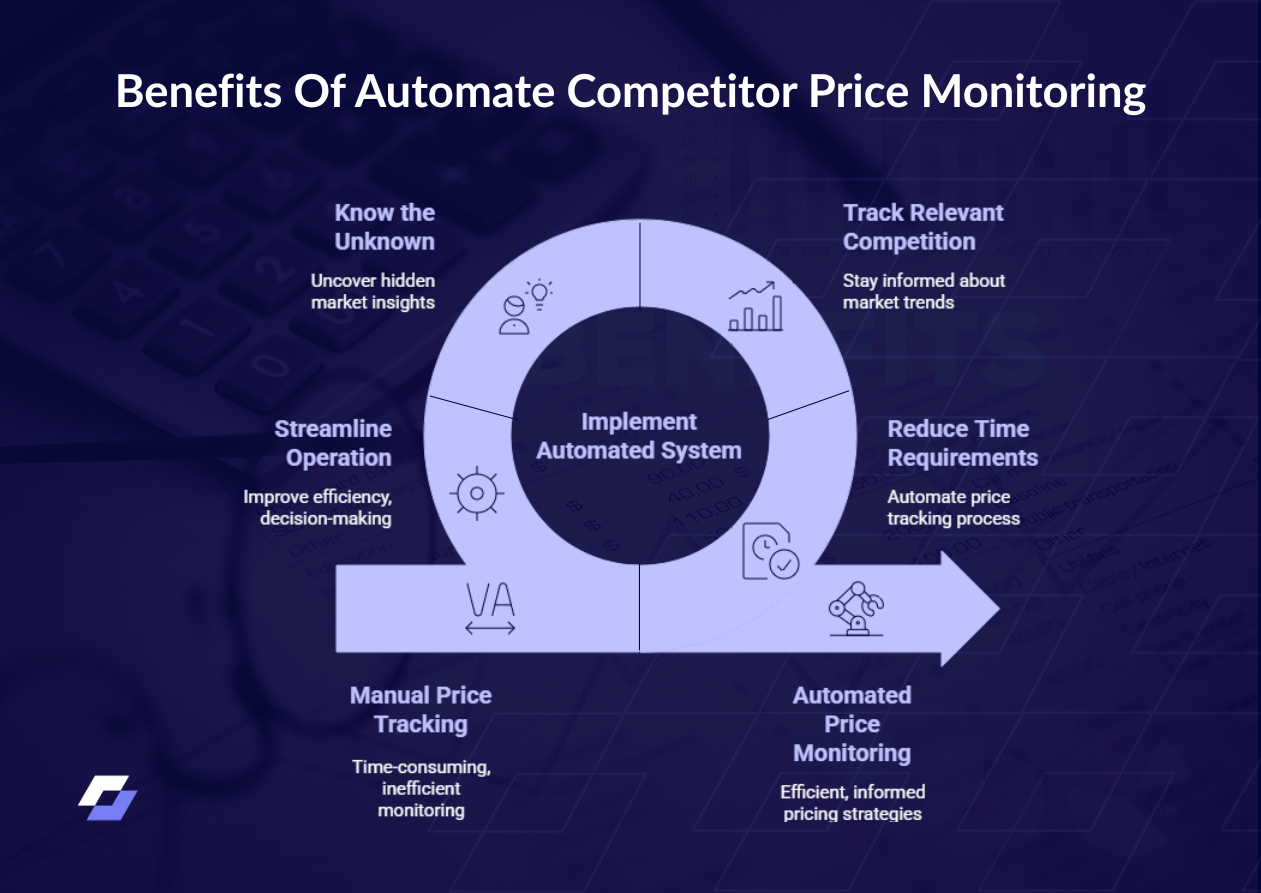
1. Time requirements
Automated price tracking in e-commerce is a must-have in environments with competition and similar products.
2. Track relevant competition
Automated systems let you examine several competitors across multiple channels including marketplaces, social networks, and official websites, ensuring you understand a broad spectrum of market dynamics.
3. Know the unknown
Automated systems let you understand pricing and competitor dynamics of thousands of products, something impossible to achieve with pure manual tracking.
4. Streamlined operation
Automation handles the collection, structuring, and analysis of pricing data which saves your team from these time-consuming tasks and allows them to shift their focus to strategy and engagement with customers.
For enterprise brands, the right competitor price monitoring tool not only tracks prices but also delivers insights into seasonal trends, demand fluctuations, and marketplace saturation. This holistic visibility supports both long-term pricing strategy and real-time market execution.
Manual vs Automated Price Tracking
Make a Difference with PriceIntelGuru
The appropriate competitor price Monitoring software can improve your pricing tactics and your entire business performance. PriceIntelGuru’s price intelligence software offers advanced automated solutions that empower businesses to stay competitive, responsive, and profitable. Price monitoring can be done through several avenues.
- Real-time Insights: Instantly adjust your price to monitor competitor price through several channels, including marketplaces, social networks and e-commerce sites.
- Customizable notifications: Integrate your business and have your staff prepare for related competitor price Monitoring to change, promotions and product discounts.
- Action driven: Take predictive market shifts, losses, and pricing compared to your competitors to make practices more profitable.
- Scalable solutions: Permit automated tracking of your price Monitoring and tracking to be burdened with dozens of SKUs.
- Enhanced team productivity: Empower your business in price Monitoring practices to the strategic exercises and tasks of promotions, expansion, and customer engagement to increase business profitability.
- Competitive advantage: Automate procedures losing competitors through automated systems to monitor competitor prices.
PriceIntelGuru supports companies across retail, automotive, manufacturing, and e-commerce verticals with end-to-end price intelligence. Businesses benefit from precise product matching, real-time updates, and strategic dashboards that transform raw data into actionable pricing decisions — a critical requirement for effective retail competitor price monitoring today.
Use PriceIntelGuru tools for automated pricing solutions and get ready to make better business decisions. Our platform gives business managers intelligence, accuracy, and time to adjust to the dynamic market, and increased ROI to prove the business performance.
Conclusion
In today's competitive e-commerce and retail landscape, staying ahead requires more than simply monitoring prices – it requires real-time insight and strategic action. While manual tracking may work for smaller catalogs, automated competitor price monitoring enables businesses to make faster, more accurate, and data-driven decisions.
Key Takeaways
- Automation saves time and resources: Focus on strategy instead of manual data entry.
- Real-time visibility: Instantly track competitive pricing across marketplaces, websites and social platforms.
- Accuracy and scalability: Eliminate human error and easily scale as your product catalog grows.
- Proactive pricing strategy: Make informed decisions, avoid price wars, and maintain profit margins.
- Competitive advantage with PriceIntelGuru: Leverage our automated solutions to optimize prices, increase revenue and stay ahead of the market.
Take the first step towards better prices today. Explore PriceIntelGuru's automated solutions and transform how your business monitors and responds to competitive pricing.